Why a Shared Field Needs More Than a Boundary
A shared field is more than a mapped edge. Learn how access, purpose and care reveal how land is used without assuming who has rights.
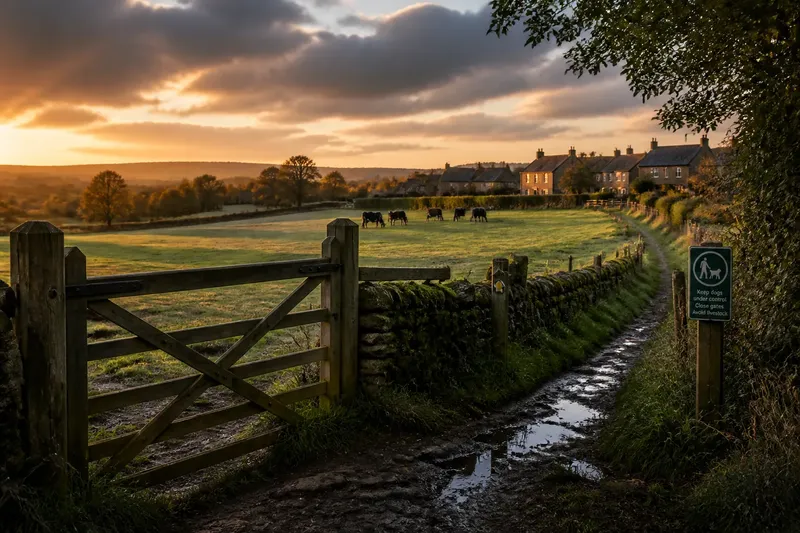
The most common mistake when reading a shared field is to treat its fence, gate, or worn track as proof of who may enter. That shortcut can lead to an awkward encounter—or to damage when someone crosses land that needs to remain undisturbed. A shared field is understood through more than its boundary: access, purpose, and care all shape what people can reasonably infer.
From a lane, you may see a gate, grass, and a cluster of animals. You cannot see every agreement, seasonal restriction, or responsibility behind them. The useful question is not simply “Where does the field begin?” but “What clues show how this place is used, and what do they leave uncertain?”
What can the boundary tell you?
Physical boundaries help people recognize a change in land use. A hedge, ditch, wall, fence, or line of trees may separate a field from a road or neighboring parcel. A gate can mark a managed entrance, while a stile or clearly maintained path may suggest that people are expected to pass through a particular point.
These features are evidence of arrangement, not a full explanation of rights. A gate may be for farm access, livestock control, or an established route. A gap in a hedge may be accidental. Even a path that looks public from the ground does not, by appearance alone, settle its legal status. When rights matter, consult the relevant local authority or a qualified professional rather than relying on landscape clues.
Read the edges as clues about movement and care, not as permission slips.
How does access change what the field means?
Access is the practical relationship between people and land: where they enter, how they move across it, and when passage may be appropriate. A field might be used by a farmer, walkers on a recognized route, neighbors with an arrangement, or several groups at different times. Those uses can overlap without being identical.
Notice whether a route is clearly marked, where it leads, and whether its surface and gates appear maintained. Look for signs about keeping dogs under control, closing gates, or avoiding particular areas. Such notices can communicate expectations, but they do not necessarily describe every arrangement. Their wording and placement matter; a sign at one entrance may address a specific route or activity rather than the whole field.
For a visitor, the safest reading is often the narrowest one: follow an identified route, respect posted directions, and do not assume that an open-looking entrance invites general access. For a resident, the same restraint helps keep casual observation separate from claims about local rights.
Which purpose is the field serving?
Shared land can support several purposes, and those purposes may shift with the season. Grass may be used for grazing or cutting. A field may also hold water, protect habitat, provide a route, or give a community room for an event. One use can be visible while another is easy to miss.
Purpose affects what “care” looks like. A quiet stretch with long grass may be deliberately left for wildlife, not neglected. A closely cut patch might be prepared for a gathering or maintained for practical access. Mud near a gateway may result from regular livestock movement, while a barrier across a path may signal temporary management rather than a permanent change.
Imagine you arrive at a field beside a village lane and see a closed gate, fresh hoof marks, and a narrow path continuing beyond it. You can note that animals have recently used the field and that a route appears to continue. You should not infer that you may open the gate, cross the pasture, or redirect the animals. The sensible next move is to check for route signs or ask the responsible local contact if access is unclear.
What does care look like on the ground?
Care is visible in small decisions: a gate that latches, a hedge allowed to grow, a clear route around a wet patch, or a notice asking visitors to avoid livestock. It may also involve restraint. Leaving a corner undisturbed or keeping vehicles away from soft ground can be a deliberate part of managing the land.
Look for patterns rather than judging one detail. A single untidy edge says little by itself. Several signs—maintained access points, managed vegetation, boundary repairs, and clear guidance—may show that someone is tending the place, though they still do not identify the full set of responsibilities.
If you use a field along a permitted route, modest habits help: close a gate as directed, keep to the established path, take litter away, and give animals space. These actions support shared use without requiring you to decide who owns or manages the land.
How do the main approaches differ?
There are three useful ways to read a shared field. They answer different questions, so choose the one that matches your reason for looking.
- Read the landscape. Follow the visible evidence: boundaries, entrances, tracks, signs, vegetation, and signs of current use. This suits a visitor or neighbor who wants to understand the setting without making claims about rights. It is quick, but it leaves formal permissions unresolved.
- Read the stated guidance. Check notices at access points and information from the relevant land manager or local authority. This suits someone deciding whether to walk a route, bring a dog, or attend an event. It can clarify current expectations, but a notice may cover only one activity or part of the land.
- Ask about the arrangement. Contact the parish or town council, land manager, farmer, or other named responsible body, depending on the context. This suits a resident organizing an activity or someone whose decision depends on a particular access right. Ask a specific question and describe the route or area you mean; if the issue is legal, seek qualified advice.
Choose the lightest approach that answers your question. If you are simply observing from a public road, landscape clues may be enough. If you intend to enter, rely on clear access guidance. If you are planning an event or disputing a right, ask the responsible body rather than filling gaps with assumptions.
What should you ask when reading a landscape?
Where is the obvious entrance?
Note whether access is directed through a gate, stile, or marked point, and whether a sign identifies a route. An entrance is a clue to how movement is managed, not proof that every visitor may use it.
What activity is visible now?
Look for livestock, cut grass, a maintained path, or temporary notices. These observations can explain why a route or area may be managed differently at the moment, but they do not establish who is entitled to enter.
What signs describe expectations?
Read the actual wording, including any limits on dogs, gates, vehicles, or access. Keep the conclusion within the sign’s scope instead of treating one notice as a statement about the whole field.
Who can clarify what remains uncertain?
Check whether a notice names a land manager, council, or other contact, then ask about the specific location and activity. If the answer concerns a formal right or dispute, an appropriate qualified professional can explain what applies.
How can you choose what to do next?
Start with your intended action. For observation, stay where you are entitled to stand and describe only what you can see. For walking, look for a recognized route and follow its directions. For an event, maintenance request, or access question, contact the body responsible for that land before making plans.
This approach keeps three things distinct: what the boundary looks like, what people appear to be doing, and what access is actually permitted. That distinction is useful in ordinary conversation, too. Instead of saying “That field is open to everyone,” try “There is a marked path through the field, and the notice says to keep the gate closed.” The second description is more precise and easier for others to check.
A shared field is not made understandable by its boundary alone. Access shows how movement is organized, purpose helps explain changing use, and care reveals the work involved in keeping the place functioning. When you need to know more, those clues can guide a good question; they should not stand in for an answer about rights. That is the most useful way to read shared land: notice carefully, act within clear guidance, and ask before turning an impression into permission.