Before the Noticeboard: How Rural Information Traveled
Explore how rural information traveled before noticeboards, from spoken messages to written records, and see what each route could preserve or miss.
The common mistake in telling the story of rural information is to imagine one standard route: neighbors passed news by word of mouth until a noticeboard replaced them. Rural information traveled in different ways from place to place, shaped by local work, meeting places, literacy, and who was available to carry a message. Looking at those possibilities makes the history clearer—and shows what a written notice could add without erasing conversation.
What routes could carry rural information before noticeboards?
Before a permanent public display, a message might travel through conversation, a letter, a posted handbill, or an announcement at a gathering. A market, place of worship, mill, inn, post office, or community meeting could serve as a point where people exchanged news, depending on what existed locally and who went there. These are possibilities, not a single pattern shared by every countryside community.
Some messages moved through people who regularly visited several households or places. Others depended on someone being present at a particular time. A spoken announcement could be repeated quickly, but a listener who missed it might not hear it at all; a detail passed from memory could also change along the way.
For a specific place and period, local records can help distinguish what is documented from what is plausible. Parish records, local newspapers, letters, diaries, and community archives may preserve evidence of particular announcements or meeting places. Without that evidence, it is better to describe a route as a possibility than as a local fact.
What could writing preserve that conversation might lose?
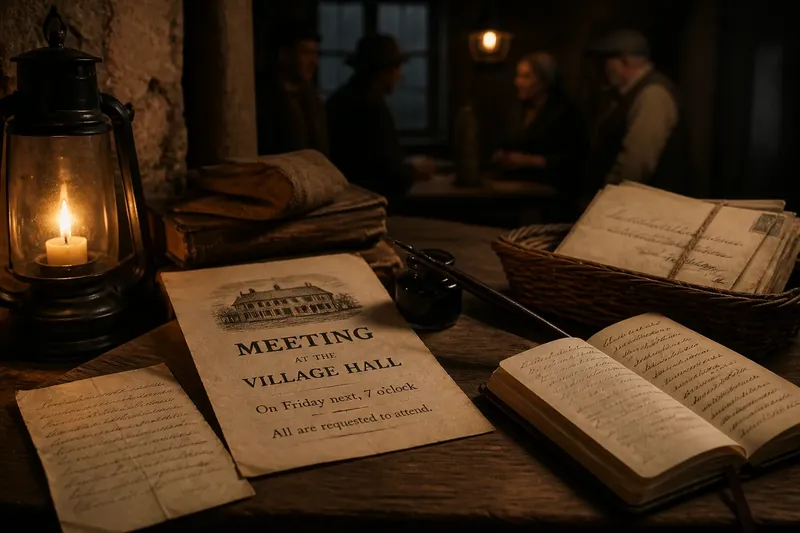
A written message could hold names, dates, places, and instructions in a form that someone might revisit. Letters and handbills could carry those details between people or locations; a notice fixed in a public place could remain available to passersby for longer than a spoken announcement.
Writing did not solve every problem. A sheet could be misplaced, difficult for some readers to use, or seen only by people who visited its location. And a written notice could become outdated just as a spoken message could be misunderstood. Each route had its own strengths and limits.
Imagine a village committee wants people to know about a meeting at a hall. In this invented situation, one member tells neighbors in person, another writes the date and place on a handbill, and a third carries copies to households farther along a lane. The spoken message may reach someone sooner, while the handbill gives readers a detail they can check again; neither route reaches everyone automatically.
How did a public meeting place shape the message?
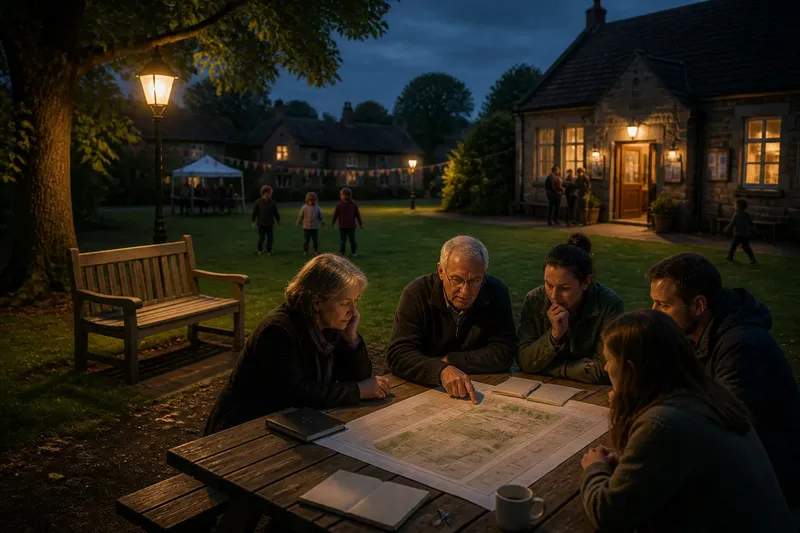
Information often gathered where people already had reason to go. A market or place of worship might bring people together for one purpose and create an opportunity to exchange news as well. The importance of any particular place depended on local habits; no single venue served every community.
That setting could affect what was heard and by whom. A message shared at a gathering reached those present, while people absent through work, distance, illness, or other commitments might depend on a later retelling. A written notice could offer another chance to encounter the information, provided it was posted somewhere people could reach and read it.
Shared places were not neutral channels: access, timing, and familiarity all mattered. A message’s route tells us something about the daily life of the people expected to receive it.
Why did the noticeboard add something without replacing conversation?
A noticeboard could give certain messages a visible, repeatable home. Readers could return to check a date or name, and organizers could display information without relying entirely on someone being present to announce it. It also created a new responsibility: someone had to choose what belonged there and keep old information from being mistaken for current.
Conversation continued to matter because a display could not answer questions or carry itself to people who did not pass it. A neighbor might explain a notice, mention it to someone who had missed it, or point out that a detail had changed. The board and conversation could work together, rather than marking a simple change from one era to another.
Think of a noticeboard as a place to check a message, not proof that every resident has received it.
What can local records tell us about an older information route?
Local evidence can turn a broad account into a grounded one. A community archive may hold a handbill or meeting notice; a local newspaper may report an announcement; a diary or letter may describe how someone learned the news. Each source answers different questions and may leave others open.
- If a dated handbill survives, check its wording and intended audience; then describe the specific message it documents, not a universal practice.
- If a newspaper reports a public meeting, check the date and place in the report; then say that the paper recorded that meeting, rather than assuming every resident read it.
- If a letter describes news arriving through a person, note who carried it and in what context; then treat it as evidence about that account, not every local message.
- If a diary mentions hearing an announcement, check whether it identifies the speaker or setting; then keep any unrecorded details explicitly uncertain.
- If sources disagree about a date or location, compare what each one actually says; then report the disagreement or seek another record instead of choosing silently.
- If no relevant record turns up, distinguish general possibilities from local documentation; then avoid presenting a plausible route as established local history.
These checks do not require a formal archive project. Even a short local account becomes more trustworthy when it names what a surviving record supports and what remains uncertain.
What do readers ask about rural information before noticeboards?
Did every rural community rely on word of mouth?
No single route can be assumed for every place or period. Spoken messages were one possibility alongside letters, handbills, gatherings, and other local arrangements.
Were written notices always available to everyone?
No. A notice had to reach a place people could access, and readers had to be able to use it. A written message could preserve details while still missing people who did not encounter it.
How can I check how information traveled in my community?
Start with local newspapers, community or parish archives, letters, diaries, and surviving handbills. Record what each source documents, and keep broader possibilities separate from evidence about your specific place.
Did noticeboards end spoken announcements?
Not necessarily. A public display could preserve details for later checking, while conversation could explain or pass along information. The two routes could complement each other.
How can a local history describe these routes responsibly?
Use precise language: “a surviving handbill shows” says something different from “residents usually heard.” Identify the place and time when the evidence allows, and avoid turning one person’s account into a claim about an entire region. If the record is thin, say so plainly.
For a useful account of rural information, keep the focus on the handoff: who conveyed a message, where it could be encountered, what details a written record preserved, and who might still have missed it. That distinction lets a local history honor both the evidence and the everyday uncertainty of how news reached a neighbor.