A Rainy-Day Walk Around a Village Green
A rainy-day walk around a village green can reveal where water gathers, which surfaces stay passable, and what to report to the local land manager.
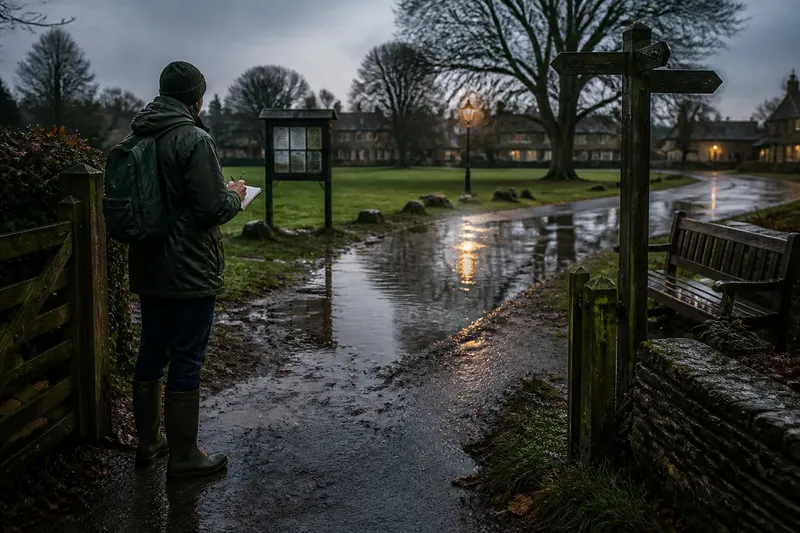
The common mistake on a rainy-day walk around a village green is to hurry straight home along the driest-looking line. That can leave you unaware of where water gathers, which surfaces stay passable, or whether a route becomes difficult to follow. A slow circuit gives you a useful picture of the ground on that particular day.
Rain can expose drainage and surface changes, but it can also make a green temporarily muddy. Keep the visit simple: choose a route you can safely retrace, avoid stepping into deep or uncertain water, and note what you see without treating one wet walk as a complete assessment.
What are you trying to find out?
Pick one practical question before setting off. You might want to know whether a puddle blocks the route to a noticeboard, where water collects after rain, or which path leads back to the lane. A focused question makes observations easier to remember.
- Water collecting: Check whether water sits in a hollow or beside a drain. If it is shallow and safely avoidable, note the location; if it is deep or hides the ground, turn back and report the hazard to the land manager.
- Surface changing: Check where paving, gravel, grass, or mud meets. If the transition remains easy to cross, continue cautiously; if it is slippery or unstable, use another safe route or return the way you came.
- Drainage clues: Check whether a visible drain is clear or covered by leaves. If it appears unobstructed, note that water still may not be draining; if debris is present, do not remove it unless you are authorized—send the location to the responsible local body.
- Route clarity: Check whether you can identify the path back from each junction. If the route is clear, continue to your chosen stopping point; if not, retrace your steps rather than guessing across wet ground.
- Safe footing: Check for slick leaves, soft edges, and loose stones. If the path feels secure, proceed at a careful pace; if your footing is uncertain, turn around or choose a firmer route.
- Useful notes: Check whether you can identify the spot later using a nearby gate, bench, or path junction. If you can, record that landmark and the visible condition; if you cannot, add a simple direction such as “beside the north lane entrance” before contacting the land manager.
Choose a question small enough to answer with what you can actually see.
Where should you start on a wet walk?
Start from a familiar point, such as the lane entrance or the path beside the village hall. That makes it easier to compare the return route with the way in, and gives you a clear stopping point if the ground becomes uncomfortable.
If your purpose is to see whether water affects a particular destination, follow the safest available path toward it. Do not cross a flooded hollow just to complete the circuit. A detour or early return is useful information too: note the point where you changed course and what made you do so.
Say you begin at the village hall path on a wet afternoon and intend to reach the noticeboard. You see water covering a low section before the next junction, so you stop short, return to the hall path, and record the nearby gate as the location. The resulting note is specific: the low section before the junction was covered during rain, and the noticeboard route could not be checked safely. It avoids claiming that the route is always blocked.
What can rain reveal about the ground?
Look for where puddles form, where mud spreads onto a path, and where the surface remains firm. Those details can help explain why people might slow down or choose another line, but they do not establish the cause. A dip in the ground, blocked drainage, recent work, or a passing storm may all affect what you see.
Notice surface changes without testing them with your weight. A grassy edge may look firm and still give way; a dark patch may be wet leaves rather than mud. Keep to ground you can judge safely, and make a note when the route seems uncertain instead of trying to prove the point by crossing it.
Record conditions plainly: “water across the path beside the oak gate” is more useful than “the green floods.” The first describes one visible condition at one location; the second makes a broader claim that a single visit cannot support.
How should you describe a concern?
If a wet-weather condition appears to affect safe use, share a short, factual note with the local council, parish authority, or land manager responsible for the green. Include the date, recent weather if known, a nearby landmark, and what you observed. Do not assume that the organization responsible for the nearest building also manages the land.
Keep your note to observations and avoid moving barriers, clearing drains, or making repairs unless you have permission and the right training. If the situation presents an immediate danger, keep away and contact the appropriate local authority or emergency service according to the urgency.
Which wet-walk questions are useful to ask?
Should you walk through a puddle to check its depth?
No. Water can hide uneven ground, holes, or slippery material. If you cannot see a safe way around it, turn back and report the location instead.
What should you do if the path turns muddy?
Stay on a firm, safe surface rather than widening a muddy track or stepping into an uncertain verge. If no safe route remains, return the way you came and note where the ground changed.
Is one rainy walk enough to identify a drainage problem?
No. A single visit shows the conditions at that moment, not their cause or how often they occur. Describe what you saw and let the land manager decide whether further checking is needed.
What details help a land manager locate a wet spot?
Name a fixed landmark, the path or approach you used, and the visible condition. If you can safely do so, include a photograph taken from the path, without entering water or photographing people unnecessarily.
What should you remember for the next visit?
A rainy-day walk around a village green is most useful when it produces a clear, modest observation: where water gathered, which surface changed, or where you turned back. If you revisit after another spell of rain, compare the same location and describe any difference without assuming the cause.
Keep the route safe and the report precise. A landmark and a plain description give the responsible local body a practical place to begin, while leaving decisions about inspection or maintenance to the people who manage the land.